Why Ball Balance Matters
A football that looks identical to another on the shelf can perform very differently in the air. The reason is internal: even a fractional offset between the ball’s geometric centre and its actual mass centre could, under match conditions, translate into subtle but measurable shifts in flight path, spin stability, and bounce predictability.
For elite-level competition, that’s not a marginal detail. It’s the difference between a free kick that potentially bends as intended and one that may flutter unpredictably. It’s the difference between a goalkeeper potentially reading a shot correctly and being deceived.
For manufacturers, it could be the difference between a ball that passes governing body certification at first attempt and one that doesn’t.
This is why FIFA, World Rugby, and other governing bodies have invested in research programmes that scrutinise ball construction at increasingly granular levels. It’s also why Sports Labs, as a FIFA Research partner, was tasked with developing a method to measure this property objectively.
The Sports Labs Balance Test Device
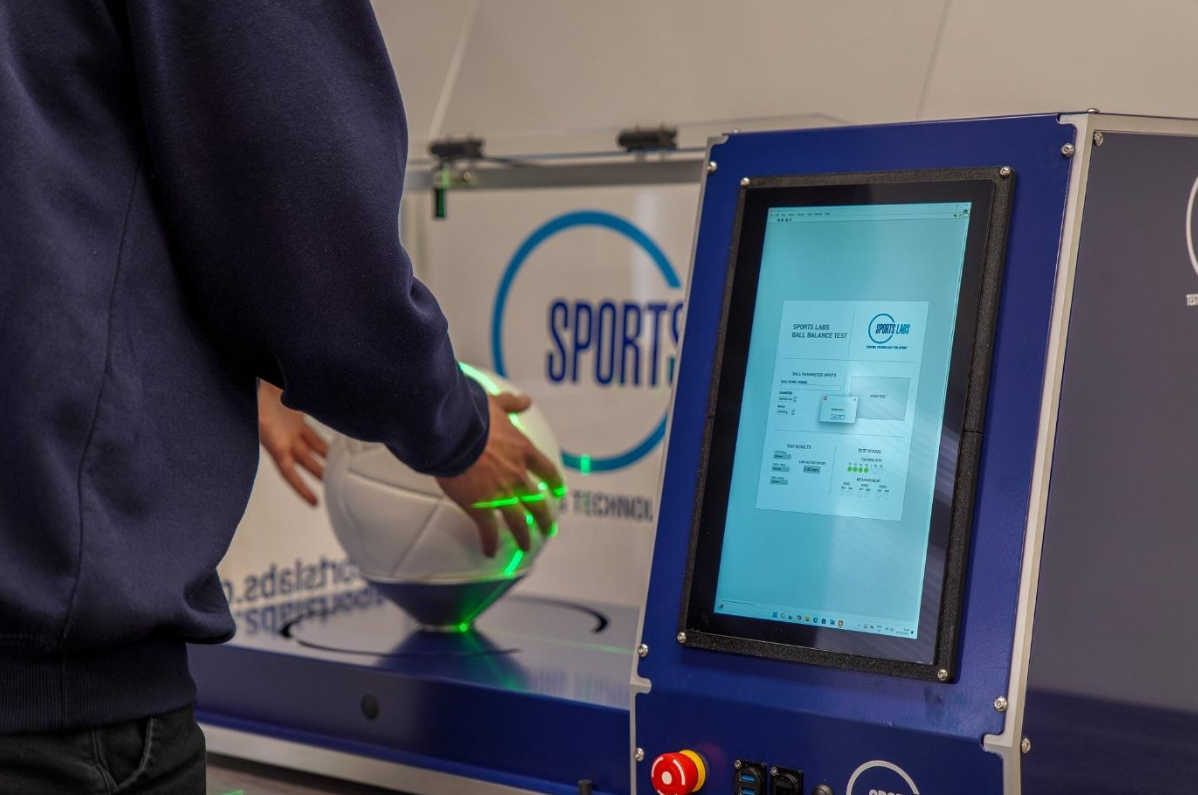
The result is a custom-built apparatus, designed, engineered, and validated entirely in-house by our Innovation and Development team under a FIFA Research contract.
What makes it different isn’t the underlying physics. Those have been understood for centuries. Iit’s the marriage of mechanical precision, automated control, and live data synthesis that produces a complete balance profile of any sports ball in under five minutes.
How the System Works
The device draws on one of the oldest principles in physics: The Law of the Lever. This device applies the law through four interlocking subsystems.
High-Precision Lever & Load Mechanics
A rigid beam is supported across a pivot point. The ball is held in a cradle at one end, while a calibrated load cell measures the resultant force at the opposing end. Any imbalance, no matter how small, registers as a force differential.
3D Vector Profiling
To build a complete picture of a ball’s balance, the device automatically rotates the ball through its X, Y, and Z axes, capturing multiple force measurements at each orientation. The three axis-specific offsets are then summed as vectors to determine the ball’s overall mass offset from its geometric centre.
Automated Laser Alignment
Two lasers ensure consistent positioning. A vertical laser aligns with the centre of the mounting cradle, while a height-adjustable laser tracks the ball’s geometric centre based on its size accommodating footballs, futsal balls, handballs, and other specimens without manual recalibration.
Real-Time Data Synthesis
The system combines the ball’s pre-test baseline mass with the force data captured across each axis, calculating the exact millimetric offset between the centre of mass and the centre of volume. The entire process completes in under five minutes and outputs a structured report immediately.
From the Pitch to Orbit and Back Again
In 2026, a video circulated of astronaut Jessica Meir on the International Space Station demonstrating the science hidden inside every ball. A football in microgravity. Free of Earth’s gravitational pull, the smallest internal imbalance became immediately visible. A slightly off-centre mass caused the ball to wobble, tumble, and spin unpredictably as it floated.
It’s the same physics our Balance Test Device measures on the ground every day, just dramatically exposed by the absence of gravity. The wobble astronauts see in zero-G is the same subtle deviation that, on Earth, shows up as a free kick failing to dip on cue, or a cross drifting unpredictably across the box.
What’s invisible to the naked eye on a pitch is unmissable in space. And what’s unmissable in space is precisely what we quantify, axis by axis, in our laboratory in Livingston.
Like What you're reading?
Subscribe and Be the first to Get the latest industry news & Updates
Non-Invasive, Universal, Reproducible
Three engineering choices set the Balance Test Device apart from any improvised or laboratory-cobbled alternative.
Preserves structural integrity
Testing is conducted at standard recommended inflation pressures. The apparatus exerts no structural force on the ball; pressure, shape, and panel tension are preserved exactly as in match conditions. The result is data that reflects how the ball actually behaves on a pitch and not a deflated or distorted approximation.
Material and size agnostic
The mechanical principles hold true regardless of brand, size, panel configuration, or construction. This makes the device equally valuable for comparative testing across a manufacturer’s range, for production-line quality control, and for forensic evaluation in a tournament context.
Automated and reproducible
Operator variation is the silent enemy of comparative testing. By automating axis rotation, laser alignment, and data capture, the device minimises operator subjectivity. This guarantee results that are reliable, repeatable, and accurate across any technician and any test device in the Sports Labs network.
What This Means for the Industry
For ball manufacturers, the implications are direct. Quality control no longer depends on subjective feel or on flight-trajectory tests that conflate ball performance with environmental variables. Internal balance can now be measured in absolute terms, batch by batch, model by model.
For governing bodies, the device provides an objective check on ball performance that complements existing certification testing.
For elite teams and tournament organisers, it offers independent verification. This is a way to confirm that match balls meet the same internal standard claimed by the manufacturer.
And for sports scientists and engineers, it opens a new line of investigation into the relationship between manufacturing tolerances, material choices, and on-field performance.
In every case, the principle is the same: what was once judged by feel is now measurable in millimetres.